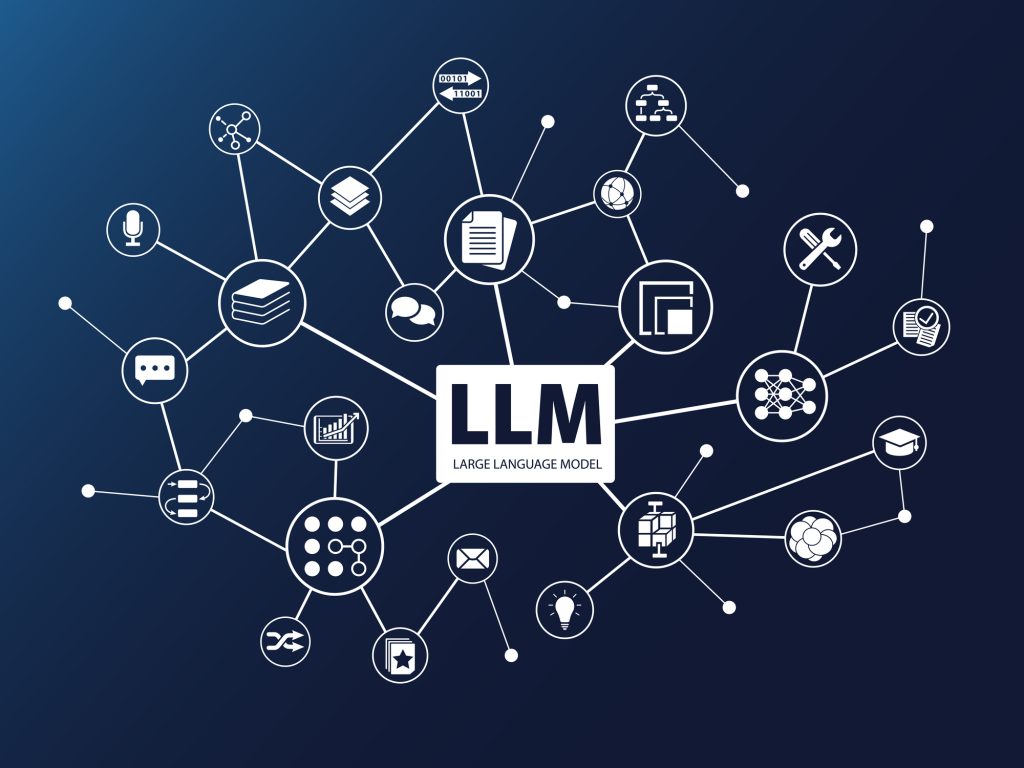
Large language models (LLMs) are AI systems trained on massive amounts of text data to understand, generate, and manipulate human language. In simple terms, it is a program that has read billions of documents and learned the patterns of language so well that it can write, answer questions, and translate with human-like fluency.
The short answer to what an LLM does: it predicts the most likely next word (or token) in a sequence, over and over, to produce coherent and contextually relevant text. That one simple mechanism, scaled to hundreds of billions of parameters, is what powers tools like ChatGPT, Claude, and Gemini.
How Do Large Language Models Actually Work?
LLMs are built on a neural network architecture called the Transformer, introduced by Google researchers in 2017. Here is the simplified journey from raw data to a working model:
- Data Collection: Trillions of words scraped from books, websites, code repositories, and academic papers.
- Tokenization: Text is broken into smaller units called tokens (roughly 3/4 of a word on average).
- Pre-training: The model learns to predict missing or next tokens, adjusting billions of internal weights.
- Fine-tuning & RLHF: Human feedback is used to align the model to be helpful, honest, and safe.
The result is a model that has no memory of what it read but has internalized the statistical relationships between words, concepts, and ideas across virtually every domain of human knowledge.
Key LLMs Compared
Here is a quick look at the leading large language models available today:
| Model | Developer | Parameters (approx.) | Strengths | Access |
|---|---|---|---|---|
| GPT-4o | OpenAI | ~1.8 trillion (MoE) | Reasoning, coding, vision | API + ChatGPT |
| Claude 3.5 Sonnet | Anthropic | Not disclosed | Long context, safety | API + Claude.ai |
| Gemini 1.5 Pro | Not disclosed | 1M token context window | API + Gemini app | |
| LLaMA 3 | Meta | 8B to 405B | Open-source, customizable | Free download |
| Mistral Large | Mistral AI | ~123B | Efficient, multilingual | API + open weights |
Real-World Applications
LLMs have moved well beyond chatbots. They are reshaping entire industries:
- Healthcare: Summarizing patient records, assisting diagnosis, drafting clinical notes.
- Software Development: GitHub Copilot and similar tools write, review, and debug code.
- Education: Personalized tutoring, essay feedback, and language learning apps.
- Legal & Finance: Contract review, regulatory document summarization, report drafting.
- Customer Support: Automating responses with human-like understanding of intent.
Even creative fields like marketing, screenwriting, and graphic design are using LLMs to accelerate ideation and production.
Limitations You Should Know
Despite their impressive capabilities, LLMs have real weaknesses:
- Hallucinations: They can confidently state false information as fact.
- Knowledge cutoff: Most models have a training cutoff and do not know recent events.
- Bias: Models reflect the biases present in their training data.
- Cost: Running large models requires significant computing power.
- No true understanding: LLMs manipulate patterns, not meaning.
These limitations mean LLMs work best as assistants, not as autonomous decision-makers.
What is Next for LLMs?
The field is evolving fast. A few trends worth watching:
- Multimodal models that handle text, images, audio, and video together.
- Smaller, efficient models running on personal devices (on-device AI).
- Agentic AI: LLMs that can use tools, browse the web, and take multi-step actions.
- Open-source growth: Meta’s LLaMA and Mistral are democratizing access.
Large Language Models are not a passing trend. They represent a fundamental shift in how software interacts with human knowledge. Understanding what they are and how they work puts you ahead of the curve.