
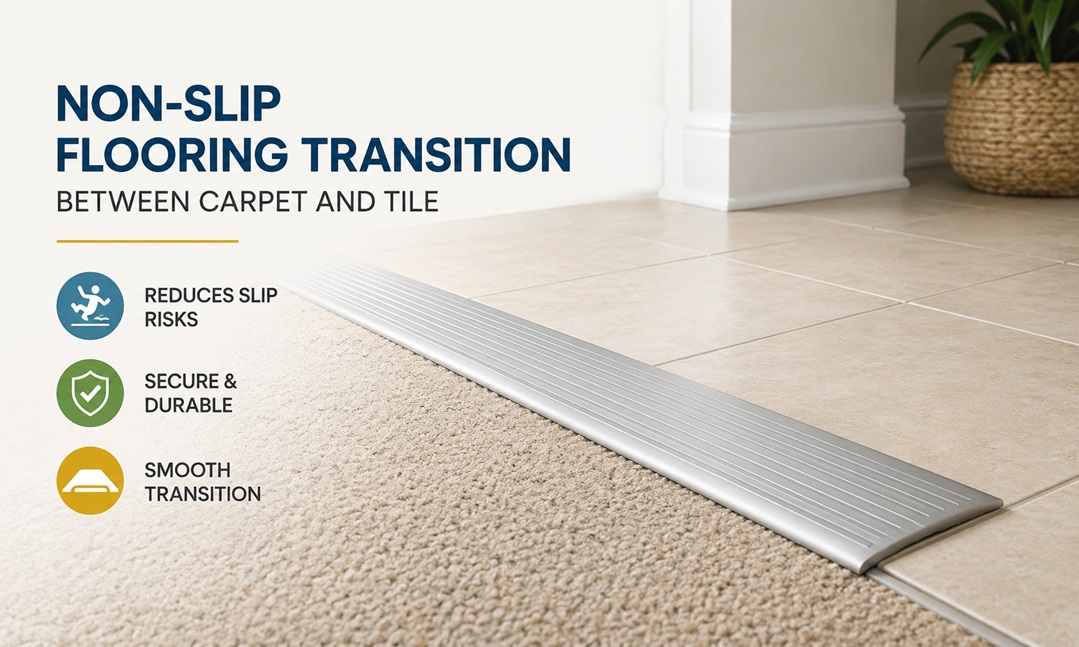
A non-slip flooring transition between carpet and tile is usually handled with a transition strip — specifically a T-bar, reducer, or threshold strip — installed where the two surfaces meet. The right choice depends on the height difference between your carpet and tile, the room’s purpose, and who will be walking through that space. Getting it wrong creates a trip hazard; getting it right makes the junction safe, clean, and durable.
What to Look For Before Buying
Before choosing a transition strip, measure the height difference between your tile and carpet surfaces. This single measurement determines which strip type you need.
If both surfaces sit at roughly the same height, a T-bar transition strip is the standard solution. The T-shaped bar sits over the seam and covers both edges cleanly.
If there is a noticeable height difference — common when thick pile carpet meets thinner tile — a reducer strip creates a sloped transition that reduces the risk of catching a toe or heel on the edge. This is especially important in households with older adults or young children.
If the tile is significantly higher than the carpet, a threshold strip with a more pronounced slope may be needed.
Material Options and What They Mean in Practice
Aluminium: The most common material. Durable, holds up to heavy foot traffic, and resists moisture. Available in silver, gold, and bronze finishes. Anodised aluminium is worth the slightly higher cost as it resists corrosion better in bathrooms and kitchens.
Rubber: Excellent for non-slip performance. Rubber transition strips are common in commercial settings and are increasingly available for residential use. They absorb impact well and are a good choice in areas where someone might be barefoot — bathrooms, laundry rooms, kitchens.
Vinyl: Flexible, affordable, and easy to cut. Not as durable as aluminium or rubber under heavy traffic, but perfectly adequate for lower-traffic areas like bedrooms or hallways.
Solid wood or bamboo: These look premium and blend beautifully with natural flooring, but they are not ideal for wet areas. They can warp if exposed to moisture repeatedly.
What Installers and Tradespeople Recommend
The most common mistake in DIY transitions is not securing the strip properly, allowing it to shift over time and create a lip that catches feet. Most aluminium T-bars use a channel system — the channel is fixed to the subfloor first, then the top bar snaps in. If the channel is not glued or screwed down properly, the bar eventually lifts.
Measure the transition gap carefully before cutting. Transition strips that are too short leave raw flooring edges exposed. Strips that are too long buckle slightly and never sit flat.
For bathrooms and kitchens, use a transition strip rated for wet areas. Standard strips are not sealed adequately against repeated moisture exposure.
Accessibility Considerations
In homes with wheelchair users, mobility aids, or frequent foot traffic from older adults, flush transition strips — those with minimal profile height — are the safest option. These are designed to meet accessibility standards and keep the floor as level as possible across the junction.
In Australia, the National Construction Code and in the UK, building regulations both address floor transition heights in accessible design contexts. A transition that rises more than 5–6mm without a slope may not meet accessibility requirements in certain property types.
A Practical Starting Point
For most residential applications, an anodised aluminium T-bar or reducer strip from a hardware or flooring retailer will do the job well and last for years. Scrub and dry the subfloor at the transition point before installing. Use the appropriate adhesive or mechanical fixing for your subfloor type.
If you are unsure about the installation, most flooring retailers will advise you for free. The strip itself is a minor cost — the labour to re-do it if done incorrectly is not.


