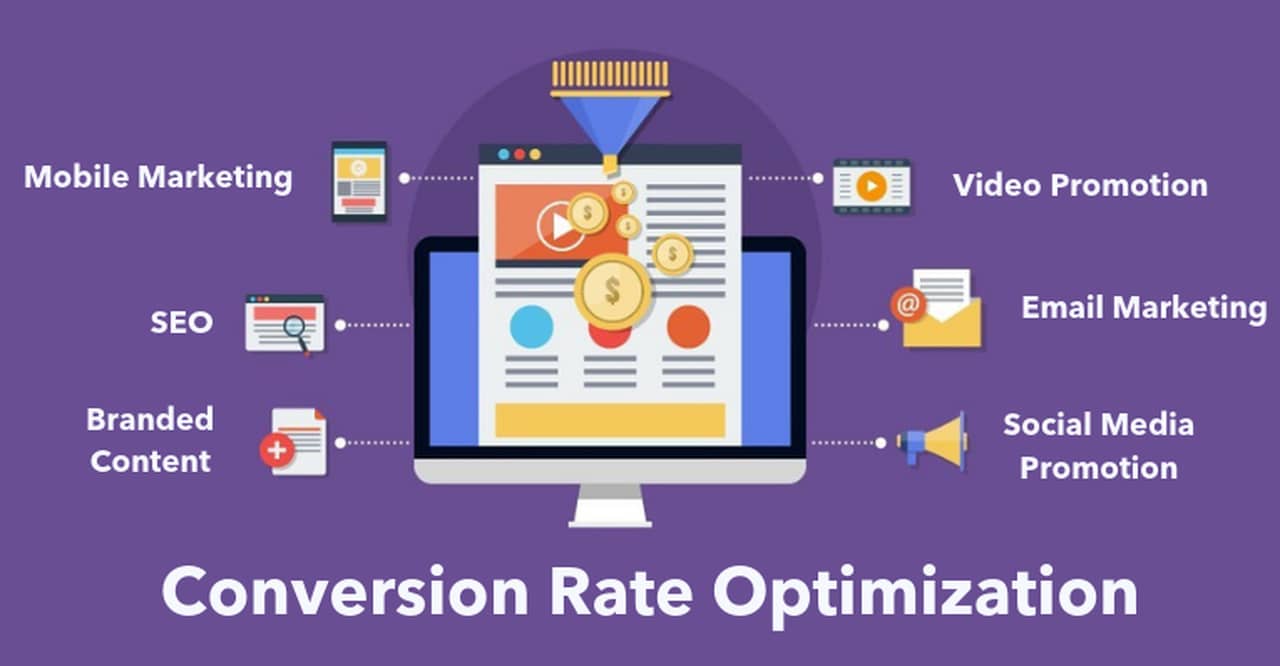
Website Conversion Optimization (CRO) is the structured process of increasing the percentage of visitors who complete a desired action—a purchase, a sign-up, a demo request, or a call. The number that matters is your current conversion rate benchmarked against your industry. A 2% ecommerce conversion rate is mediocre in fashion but decent in complex B2B software; knowing where you stand tells you how urgently you need to act.
Most CRO fails because it skips the research phase and jumps straight to testing. Changing a button colour without understanding why users are not converting is a lottery, not optimization. The teams that consistently improve conversion rates follow a research → hypothesis → test → analyse cycle – and they spend more time on research than anything else.
Industry Conversion Rate Benchmarks
| Industry | Average Conversion Rate | Top 25% Performers | Key Driver |
|---|---|---|---|
| Ecommerce (general) | 2.5 – 3.5% | 5%+ | Trust signals, checkout friction |
| B2B SaaS (free trial) | 3 – 5% | 8%+ | Value clarity, social proof |
| B2B Lead Gen (form) | 2 – 4% | 6%+ | Form length, offer relevance |
| Travel & Hospitality | 2 – 3% | 5%+ | Price transparency, urgency |
| Finance / Insurance | 3 – 5% | 7%+ | Trust, compliance clarity |
| Healthcare | 3 – 4% | 6%+ | Privacy reassurance, simplicity |
| Real Estate | 1 – 2% | 3.5%+ | Personalisation, response speed |
| Education / Courses | 1.5 – 3% | 5%+ | Outcomes focus, testimonials |
The CRO Research Stack: Before You Test Anything
Good CRO starts with understanding why people are not converting – not guessing and testing randomly. Use these tools in combination:
Heatmaps and click maps (Hotjar, Microsoft Clarity): Show where users click, tap, and where their attention concentrates. Reveal elements users think are clickable but are not, and important CTAs being ignored.
Session recordings: Watch real users navigate your site. Fifteen recordings of someone struggling with your checkout form tells you more than a month of A/B test data. Look for rage clicks, hesitation patterns, and exit points.
Funnel analysis (GA4, Mixpanel): Map every step from landing to conversion. Each drop-off point is a specific problem to solve, not a general ‘conversion problem.’
On-site surveys (Hotjar, Qualaroo): Ask users who are about to leave: ‘What stopped you completing your purchase today?’ The answers will surprise you. Real objections rarely match what the team assumed.
User testing (UserTesting, Maze): Five moderated sessions with people matching your target persona reveal usability problems invisible to anyone who knows the product well.
High-Impact Elements to Test First
| Element | Why It Matters | What to Test | Effort | Impact Potential |
|---|---|---|---|---|
| Value proposition / headline | First thing visitors process; sets or kills intent | Benefit-led vs feature-led; specific vs general | Low | Very High |
| Primary CTA copy | Action instruction; specificity drives clicks | ‘Get Started’ vs ‘Start Free Trial’ vs ‘See Pricing’ | Very Low | High |
| Form length | Every field is a drop-off risk | Remove optional fields; multi-step vs single page | Low | High |
| Social proof placement | Trust signals reduce hesitation | Near CTA vs header vs reviews page | Low | High |
| Page speed (especially mobile) | Every 1-second delay reduces conversions ~7% | Image compression, script deferral | Medium | Very High |
| Checkout flow | Most abandoned at checkout – friction kills | Guest checkout, address auto-fill, payment options | High | Very High |
| Trust signals | Security badges, guarantees, returns policy | Placement, specificity, visual design | Low | Medium-High |
| Navigation / distraction removal | Option paralysis reduces conversions | Remove nav from landing pages / checkout | Low | Medium |
A/B Testing: How to Do It Without Wasting Months
Most A/B tests run by marketing teams are statistically invalid – they run for too short a period, end when one version looks better (peeking), or use sample sizes that cannot detect the effect size they are chasing. Here is the correct process:
- Define success before you start: what metric proves the test worked? Primary metric (conversion rate) and guardrail metric (revenue per visitor) – never optimise one while breaking the other.
- Calculate required sample size: use a calculator (Evan Miller’s is free). A test detecting a 10% lift with 95% confidence on a 3% baseline conversion rate needs about 30,000 visitors per variant. If you get 500 visits a week, that test takes over a year. Test bigger changes on smaller sites.
- Run for at least 2 full business cycles (usually 2 weeks minimum) to smooth out weekday/weekend variance.
- Do not peek and stop early when a variant leads. Early leads are statistical noise. Let the test reach pre-determined sample size.
- Analyse at 95% confidence minimum. ‘Trending toward significance’ is not significant.
CRO Test Ideas Ranked by Effort vs Impact
| Test Idea | Effort | Impact | Start With? |
|---|---|---|---|
| Rewrite headline to lead with specific benefit | Low | High | Yes |
| Change CTA text from generic to specific | Very Low | High | Yes |
| Add a money-back guarantee near checkout CTA | Low | High | Yes |
| Remove optional form fields | Very Low | Medium-High | Yes |
| Add customer photo testimonials near CTA | Low | Medium-High | Yes |
| Remove navigation from landing pages | Low | Medium | Yes |
| Add exit-intent popup with offer | Low | Medium | Yes |
| Test button colour (without copy change) | Very Low | Low | No – overrated |
| Complete page redesign | Very High | Variable | No – test elements first |
| Add live chat widget | Medium | Medium | After easier wins |
What NOT to Test (Common Time-Wasters)
- Button colour alone, without copy changes. The data on this is clear: colour matters in context of the whole page, not in isolation.
- Minor copy tweaks like ‘Submit’ vs ‘Send’ on high-traffic, low-stakes pages – not worth statistical significance calculation.
- Elements below the fold before fixing obvious problems above the fold. Fix the leaking roof before replacing the carpets.
- Features your users did not ask for. If session recordings show no one scrolling to the bottom of your product page, adding a video there fixes nothing.
Free vs Paid CRO Tools
| Tool | Type | Free Option? | Best For |
|---|---|---|---|
| Microsoft Clarity | Heatmaps + recordings | Fully free | Most sites – no traffic limits |
| Hotjar | Heatmaps + surveys + recordings | Free tier (limited) | Surveys + recordings combined |
| Google Optimize (sunset) → VWO / Optimizely | A/B testing | VWO has free trial | Serious A/B testing programmes |
| GA4 | Funnel + traffic analytics | Free | Funnel drop-off analysis |
| Unbounce / Leadpages | Landing page builder with built-in testing | Paid only | Landing page-focused CRO |
| UserTesting | Moderated user research | Paid only | Qualitative insight before quantitative testing |